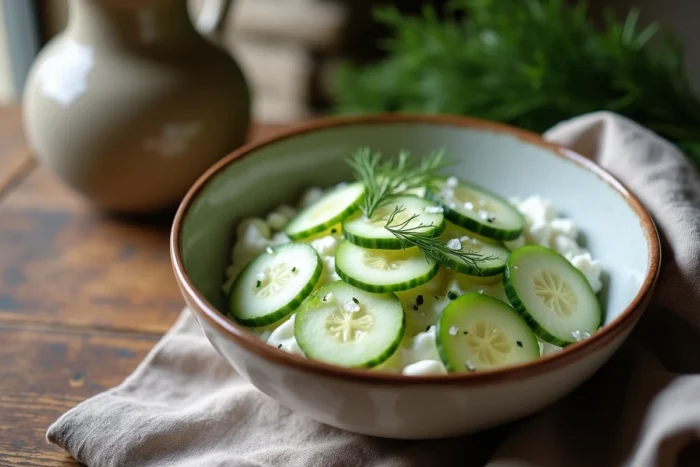
The cucumber with cream is found on almost all French crudités buffets, from school canteens to neighborhood brasseries. This omnipresence masks a precise trajectory: that of a dish that has transitioned from the domestic garden to a standard in collective catering in just a few decades. What factors have transformed a simple combination of vegetable and fresh cream into a national culinary marker?
Cucumber with Cream: A Dish Codified by Household Cookbooks
Online competitors focus on the recipe, the draining process, or seasoning variations. None address the mechanism that has fixed this dish in the French repertoire. Codification occurs through writing.
The major household cookbooks, starting with the reissues of La Cuisine de Madame Saint-Ange, include cucumbers with cream in their sections on “cold starters” and “crudités.” The formula is locked in: fresh cream, vinegar or lemon juice, chives or parsley. This structure then appears in recipe cards of women’s magazines (Elle, Marie Claire, Cuisine et Vins de France) between the 1970s and 1990s.
The repetition of this base in dozens of publications has produced a normative effect. The dish was not invented by a famous chef nor tied to a specific region. It has established itself through editorial accumulation, like grated carrots or celery remoulade. To delve deeper into the origin of cucumber with cream on La Cuisine de Watoote, the historical journey of this dish is detailed precisely there.

Collective Catering and Canteens: The Vector for the Spread of Cucumber with Cream
The transition from cookbook to meal tray occurs during the Glorious Thirty years. Standardized crudités buffets become widespread in school canteens, administrative restaurants, and collective catering structures between the 1950s and 1970s.
Uniform technical sheets, developed by municipal catering services and then by major groups in the sector, establish the weights, preparation times, and combinations. Cucumber with cream ticks all the boxes for mass catering: a vegetable available in large quantities, a cream and vinegar-based sauce that can be prepared in advance, and a plating that requires no cooking.
| Criterion | Cucumber with Cream | Celery Remoulade | Grated Carrots with Vinaigrette |
|---|---|---|---|
| Cooking Required | No | No | No |
| Sauce Base | Fresh cream, vinegar or lemon | Mustard mayonnaise | Vinaigrette |
| Associated Herb | Chives, parsley, dill | Parsley | Parsley (optional) |
| Prior Draining | Frequent (salt, resting) | No | No |
| Perception of Freshness | Very high | Medium | Medium |
This table highlights a particularity of cucumber with cream compared to other classic crudités: the salting process is the only additional technical step. Despite this constraint, the dish has remained in menu rotations because the sensation of freshness it provides has no equivalent in the standard trio of crudités.
The Recipe for Cucumber with Cream: Why the Base Has Changed Little
When comparing formulations from the 1970s with those published today, the differences are minimal. The structure remains the same: cucumber sliced into rounds, salt for draining, thick fresh cream, acidity (white vinegar or lemon), fresh herbs, pepper.
The variations focus on three points:
- The partial or total replacement of fresh cream with plain yogurt or cottage cheese, to lighten the sauce without altering the base texture
- The addition of less traditional herbs (dill, mint) that refresh the aromatic profile without changing the dish’s architecture
- The elimination of the draining step, advocated by some cooks who prefer to retain the crunchiness and accept a bit more water on the plate
The stability of the recipe partly explains its status as a classic. A dish that does not mutate from one generation to the next eventually becomes a reference. Families pass it down as is, without adaptation, because there is nothing to adapt.
Cucumber Salad and Summer Freshness: What the Dish Says About the French Table
Cucumber with cream serves a specific function in the composition of a French meal. It opens the meal, refreshes the palate, and prepares for the main course. This position as a cold starter is not trivial: it reflects the tripartite structure of starter-main course-dessert characteristic of French gastronomy.
In other culinary traditions, seasoned cucumber accompanies the main course (Greek tzatzíki, Indian raïta, Korean oi-sobagi). In France, it precedes. This positioning in the meal’s progression has reinforced its perception as an autonomous dish, rather than a condiment or side dish.
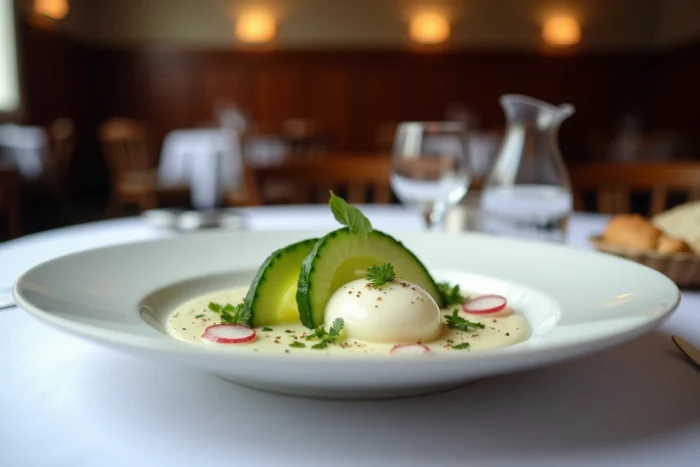
Seasonality plays a complementary role. Cucumber remains associated with spring and summer, periods during which French production is most abundant. Collective catering sheets also include this dish in menus from May to September, which maintains the link between cucumber with cream and summer warmth.
The journey of this dish, from the garden to the technical sheets of collective catering, then from women’s magazines to family tables, outlines a pattern of diffusion through gradual normalization. No starred chef, no founding event: cucumber with cream has become a French classic through repetition, simplicity, and alignment with the constraints of everyday dining.