We turn left to enter a residence, we signal, we check the rearview mirror, and yet there is the impact. The vehicle coming from the opposite direction or the one overtaking from behind hits the left side.
In the vast majority of these situations, it is the driver turning left that the insurer designates as responsible. The Highway Code requires anyone changing direction to ensure that the maneuver can be done safely, with or without signaling.
The amicable report: boxes to check and mistakes that change everything
Before discussing priority rules, let’s talk about the document that concretely determines the next steps: the amicable report. On the ground, we regularly see drivers checking an inappropriate box or forgetting to fill in the sketch. Each checked box triggers a specific scale in the IRSA convention used between insurers.
Checking the box corresponding to the left turn results in total liability in the conventional scale. In a car accident while turning left, the sketch then becomes the most useful piece of evidence to nuance the situation, because the boxes do not tell the whole story.
The sketch must show the exact position of the vehicles at the moment of impact, the direction of traffic, the signage, and any road markings. A hastily drawn sketch, without directional arrows or indication of the solid line, allows the insurer to interpret freely, and this interpretation rarely favors the one turning.
- Trace the axes of the road with the ground markings (solid line, dashed lines, absence of markings)
- Indicate the point of impact on each vehicle with a precise cross, not a vague circle
- Add an arrow for the turn signal if it was activated, even if this is not enough to reverse liability
- Note the presence of witnesses and their position, including if they were in one of the vehicles
Liability of the left-turner in the face of an illegal overtaking
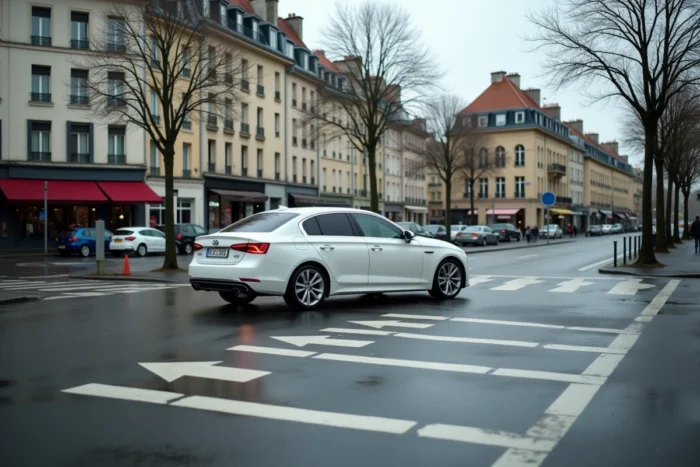
The most disputed situation is when a vehicle hits you while overtaking by crossing a solid white line. One might think that the fault lies entirely with the overtaking driver. In practice, liability is often shared 50/50.
The logic is as follows: the fault of the other driver does not exempt you from your own obligation of vigilance. Even if the overtaking was illegal, the insurer considers that you should have checked that no one was overtaking you before turning. Responses vary on this point depending on the companies, but the 50/50 split remains the most common scenario in this configuration.
When liability shifts further
Several factors can tip the balance. If the point of impact is on the left rear door or the rear bumper, it suggests that the turning maneuver was already well underway when the overtaking began. The insurer can then reduce the share of responsibility of the turning driver.
Conversely, an impact on the left front wing indicates that the driver cut off the road when the overtaking vehicle was already at their level. In this case, liability leans more heavily on the one turning left.
Refusal of priority during a left turn: penalties and consequences on car insurance
Refusing priority while making a left turn constitutes a fourth-class offense. In practical terms, this results in a deduction of 4 points from the driving license and a fixed fine, with an increased fine that can reach 375 euros in case of non-payment.
From the insurance perspective, total liability means that your insurer compensates the damages of the other driver. If you only have third-party insurance, your own repairs remain your responsibility. And upon renewal of the contract, a penalty applies to your reduction-increase coefficient.
Bodily compensation despite fault
A point often overlooked: being found responsible does not prevent you from being compensated for your injuries. The Badinter law of July 5, 1985 protects victims of traffic accidents involving a motor vehicle. Even the at-fault driver can obtain bodily compensation, except in cases of gross negligence that constitutes the exclusive cause of the accident.
This means that if you are injured while turning left and the accident involves another vehicle, your bodily injury will be covered, even if you are deemed 100% responsible for material damages. The distinction between bodily and material compensation escapes many drivers who refrain from reporting their injuries thinking they are not entitled to anything.
Filling out the report when the other party refuses or is absent
On the ground, it happens that the other driver refuses to sign the report or leaves the scene. In this case, you fill out your part of the report alone, noting the license plate, make, and color of the opposing vehicle. Photos taken immediately (damage, position of vehicles, ground markings, signs) partially replace the contradictory sketch.
A police report is necessary if the other driver has fled. The police or gendarmerie report will serve as a document for the insurance file. Without this document or witnesses, the insurer will handle the claim based solely on the declared elements, which leaves little room for contestation.
The left turn remains one of the most accident-prone maneuvers in urban areas. The presumption of liability weighs on the one turning, and only a rigorously filled report, with a precise sketch and photos, allows for documenting mitigating circumstances. Keeping a pen and a blank report in the glove compartment is not an outdated reflex.