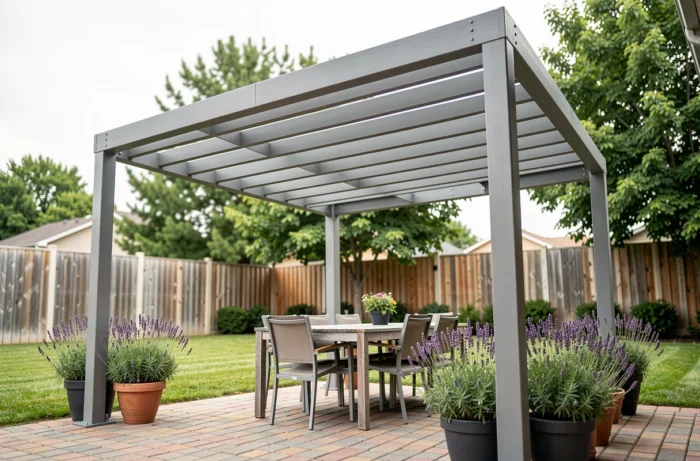
A 5×4 pergola covers approximately 20 m² of surface area, equivalent to a living room. At this size, the mechanical constraints (wind load, rain load on the roof) and regulatory requirements differ significantly compared to a freely placed 3×3 gazebo. Therefore, choosing a 5×4 pergola from Brico Dépôt involves comparing parameters that the in-store label does not always clearly prioritize: load-bearing material, wood treatment class, type of anchoring, and compliance with urban planning codes.
Wood or aluminum pergola in 5×4: comparison of durability criteria
Brico Dépôt offers kit pergolas in two main materials: treated pine and powder-coated aluminum. The differences in behavior over time warrant a detailed examination.
| Criterion | Wood pergola (treated pine) | Aluminum pergola |
|---|---|---|
| Weather resistance | Depends on the use class (minimum class 3, class 4 recommended) | Resistant to moisture, anti-corrosion powder-coated finish |
| Maintenance | Stain or saturator every two to three years | Cleaning with soapy water |
| Structural rigidity over 5 m span | Large section beams required to avoid sagging | Reinforced profiles, integrated bracing on some models |
| Customization | Cutting and painting possible | Custom configurator available at Brico Dépôt |
| Indicative budget | Generally cheaper to purchase | Higher, but nearly zero maintenance cost |
The choice between wood and aluminum mainly hinges on the balance between the initial budget and the time you are willing to dedicate to maintenance. For those looking for a durable 5×4 Brico Dépôt pergola without regular intervention, aluminum has a clear advantage over time.
Use class and wood treatment: the technical parameter to check in-store
Kit wood pergolas sold in DIY superstores use treated pine. This process injects a fungicidal and insecticidal product under pressure into the fibers. The determining variable is the wood use class, graded from 1 (dry interior) to 5 (immersion in saltwater).
For an outdoor pergola exposed to the elements without permanent contact with the ground, class 3 is the minimum viable. Class 4 provides additional resistance when the posts are in direct contact with damp ground or footings.
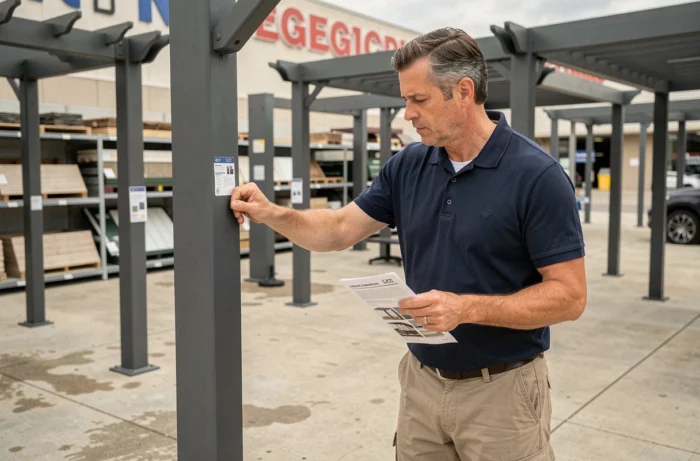
In-store, this information is found on the product’s technical label, but it is rarely highlighted on the main packaging. Always check it before purchase. Pine treated to class 2 exposed outdoors will show signs of degradation (graying, fungi) much more quickly.
Maintenance after assembly: what separates five years from fifteen years
Even with a good class autoclave treatment, exterior wood requires periodic maintenance. The two main options are stain (which colors and protects) and saturator (which nourishes the wood without forming a film). A treatment every two to three years preserves the structure and slows the natural graying of pine.
Aluminum, on the other hand, requires no protective treatment. Seasonal cleaning is sufficient to maintain its original appearance.
Ground anchoring of a 5×4 pergola: the weak point of DIY kits
On a surface of 20 m², wind load becomes a major structural factor. Kits generally include bolted fixing plates, but the quality of the anchoring depends on the receiving support.
- On concrete slab: anchoring with chemical or mechanical anchors. This is the most stable configuration, provided the slab has sufficient thickness to absorb tensile forces.
- On loose ground or footings: standard plates are insufficient. Buried concrete blocks or sealed metal sleeves are necessary to ensure stability against gusts.
- On raised wooden deck: the fixing must go through the decking and reach the supporting structure below, not just the decking boards.
Ignoring this point turns a properly sized pergola into an unstable structure at the first strong gusts of wind. Bracing (diagonal reinforcements between posts and beams) is a serious indicator on kit models: its presence or absence radically changes the rigidity of the whole.
Preliminary declaration and urban planning for a 5×4 pergola: what the 2026 decree changes
A 20 m² pergola falls exactly on a regulatory threshold. Since the decree n° 2026-117 of February 20, 2026, projects creating more than 5 m² of ground coverage require a preliminary declaration up to 20 m². Beyond that, a building permit is required.
In urban areas covered by a PLU, this threshold can be raised to 40 m² for certain projects, which places a 5×4 attached pergola within the scope of a simple preliminary declaration in most urban municipalities. However, outside PLU areas, the 20 m² corresponds exactly to the upper limit of the preliminary declaration, with no margin.
Ten-year warranty: a often overlooked point for attached pergolas
A ruling from March 21, 2024, clarified that certain ancillary structures, including pergolas, may fall under the ten-year warranty when they are inseparable from the main building. A 5×4 pergola anchored to the facade, whose removal would compromise the waterproofing of the load-bearing wall, falls into this category.
In practice, this means that installation by a professional may entitle you to a mandatory ten-year insurance from the installer. For a DIY kit assembly, this protection does not apply, placing the entire risk on the individual.
5×4 bioclimatic pergola at Brico Dépôt: a justified extra cost for comfort
Bioclimatic pergolas with adjustable slats represent the high-end of the catalog. Their benefit in a 5×4 format lies in the precise management of sunlight and ventilation over a large covered area.
The additional cost compared to a fabric or polycarbonate roof pergola is significant. It is justified if you use the covered space as a true outdoor room utilized for a large part of the year. For limited seasonal use during the summer months, a classic structure with a retractable fabric or fixed roof serves the same purpose at a lower cost.
Moreover, the 5×4 bioclimatic format requires reliable motorization for slat orientation: at this span, manual operation becomes impractical on a daily basis.
The choice of a durable 5×4 pergola hinges on three concrete trade-offs: the material (aluminum for longevity without maintenance, wood for the initial budget), the quality of ground anchoring (which conditions mechanical stability far more than the structure itself), and regulatory compliance with the 2026 decree that places the 20 m² at a critical threshold. Checking these three points before proceeding to checkout avoids unpleasant surprises in the years following installation.