
A student who obtains a bachelor’s degree in France can apply for a master’s program in Brussels, Munich, or Lisbon without having to revalidate their credits from scratch. This scenario, commonplace today, did not exist before the implementation of the LMD system. The bachelor’s-master’s-doctorate structure organizes university studies into three levels recognized in almost all European countries, and its concrete mechanisms deserve attention.
Compensation between semesters and capitalization of ECTS credits
ECTS credits are often referred to as a simple counting unit. In the daily life of a student, it primarily serves as a safety net. Each validated unit of study is permanently retained, even in the case of repeating a year or changing direction.
Capitalization changes the game for those who interrupt their studies. A student who stops in the second year of their bachelor’s degree retains the credits earned. If they return three years later, at the same university or elsewhere, the validated credits are not lost.
Recent study regulations also specify the terms of compensation between semesters. The University of Paris 1 Panthéon-Sorbonne, for example, adopted a general study regulation for the bachelor’s and master’s programs in 2024 for the training offer 2025-2030, formalizing the rules of compensation, attendance, and validation.
This type of multi-year framework, stabilized over five to six years, provides students with clear visibility on the conditions for progression, resits, and continuous assessment. To learn more about the LMD bachelor’s degree, the functioning of this first level is precisely based on this logic of semester capitalization.
Concrete organization of the three levels of the LMD
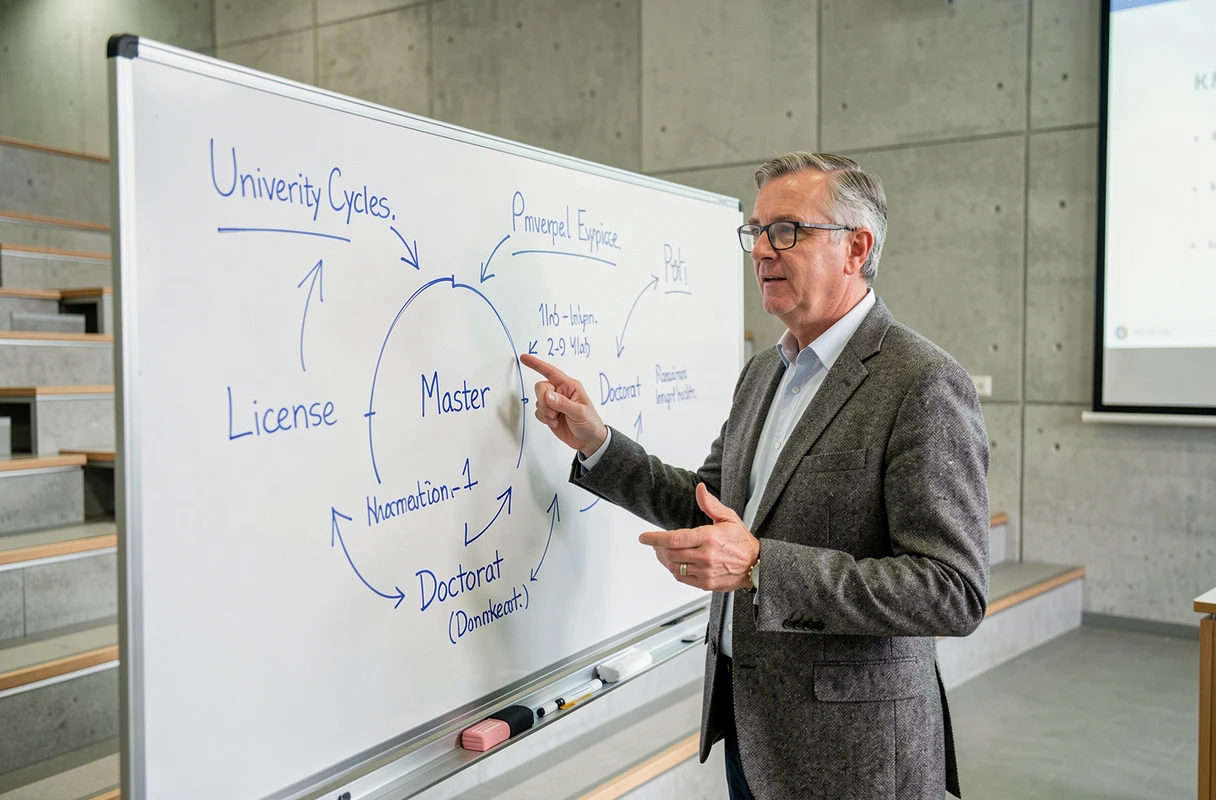
The bachelor’s degree takes place over six semesters after the baccalaureate. The master’s adds four semesters. The doctorate extends for several additional years, depending on the discipline and research pace.
Each validated semester corresponds to 30 ECTS credits. A complete bachelor’s degree therefore represents 180 credits, and a master’s totals 300. This division into semesters, rather than years, facilitates mobility: a student can spend a semester abroad and have it recognized without losing time.
Diploma, degree, and national recognition
People often confuse diploma and degree. The diploma is issued by a specific institution. The degree (bachelor’s, master’s, doctorate) is conferred by the state and guarantees a level recognized throughout the territory. A degree confers national value to the diploma obtained.
Since the early 2020s, several regulatory texts have more finely framed the issuance of diplomas within the LMD framework, notably through section D613-1 and following of the Education Code. These provisions strengthen the national coherence of curricula and validation conditions, beyond the simple three-level architecture.
European mobility: what the LMD really changes on the ground
The LMD system emerged from the Bologna process, which aimed to harmonize degrees at the European level. On the ground, this harmonization translates into a concrete mechanism: ECTS credits serve as a common currency between European universities.
A French student in a master’s program can take a semester abroad and transfer their credits without a cumbersome equivalence procedure. Recognition works both ways: a foreign student arriving in France has their credits recognized by the host university.
Feedback varies on this point depending on the disciplines and institutions. Some universities apply stricter conversion criteria than others, especially for highly specialized programs. Harmonization is not total, but the ECTS framework significantly simplifies the processes compared to the old pre-Bologna system.
- A validated semester in a country that is a signatory to the Bologna process is worth 30 ECTS credits, directly transferable to another participating institution.
- Capitalization allows for building a pathway across multiple universities without starting from scratch with each change.
- Equivalences between French and foreign diplomas are facilitated by the clarity of the bachelor’s-master’s-doctorate division.

Validation of acquired skills and resuming studies within the LMD framework
The LMD system does not only concern students in initial training. Individuals resuming studies or undergoing retraining can leverage their professional experience to obtain some of the credits necessary for a diploma.
This mechanism for validating acquired experience (VAE) aligns with the LMD structure. A professional can, for example, directly obtain part of the bachelor’s credits based on their background, then complete the missing units of study.
What this implies for the organization of training
Universities are gradually adapting their curricula to integrate these audiences. There are modules with full continuous assessment, evening or distance learning course formats, and adjusted calendars in certain semesters. The semester structure of the LMD facilitates these adjustments, as a semester forms an autonomous block of 30 credits.
- Capitalization protects working students who can only validate a limited number of units per semester.
- Multi-year study regulations, such as the one adopted by Paris 1 for 2025-2030, set the rules for resits and compensation over several years, providing predictability for those resuming studies.
- The division into ECTS credits allows for building a diploma at one’s own pace, without a time limit for capitalizing on validated units.
The LMD system has transformed the French university landscape by making pathways clearer and more flexible. Its strength lies less in the three-level architecture than in the operational mechanisms that accompany it: credit capitalization, semester compensation, and European recognition. These concrete tools determine, on a daily basis, the real flexibility students have in constructing their pathways.