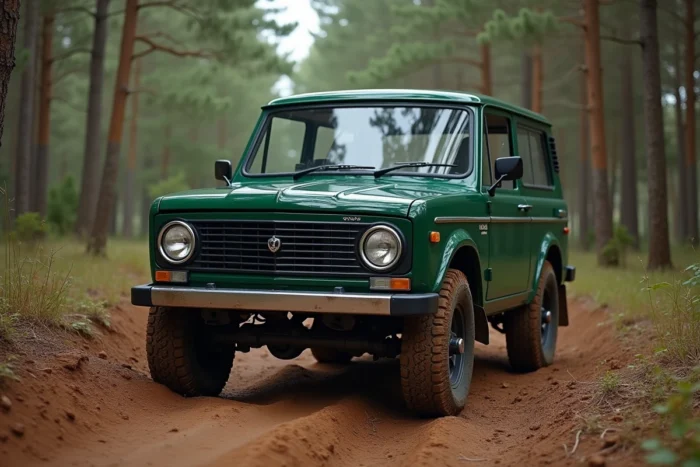
The Lada Niva 2026 arrives on a minefield: a project inherited from Renault’s CMF-B platform, taken over by the Russian institute NAMI after the sale of Avtovaz for a symbolic rouble, and now developed without the technical support of the Diamond. Understanding what this compact 4×4 is really worth at purchase involves dissecting its technical specifications, its homologation limits in Europe, and the overall budget that needs to be anticipated.
1.8-liter engine and modernized chassis: what the Niva 2026 technical sheet changes
The Niva Legend 2026 abandons the old block in favor of a 1.8-liter gasoline engine developing 90 hp and 153 Nm. The gain in torque compared to the old 1.7-liter remains modest, but the curve is more usable at low revs, which corresponds to the vehicle’s off-road use.
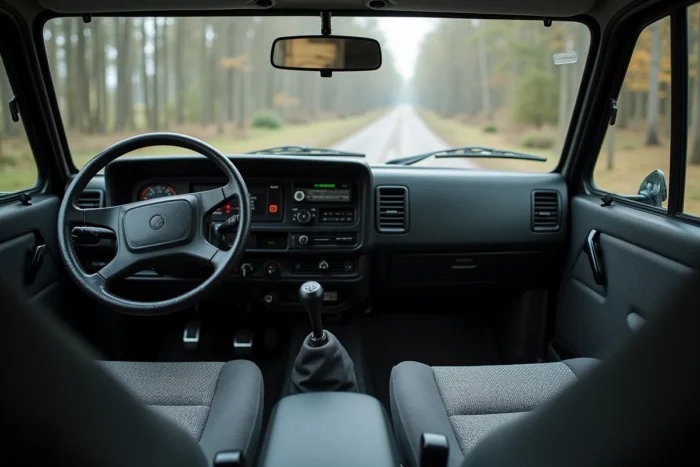
On the safety side, the big novelty is the introduction of a first driver airbag in the history of the Niva. More than 100 new parts and 60 modified components accompany this update, with galvanized body elements that significantly improve corrosion protection, a historical Achilles’ heel of the model.
The chassis and brakes have been revised. We observe that the technical base remains that of a vehicle designed in 1977, with permanent all-wheel drive and a transfer case with a reducer. No modern electronic assistance (latest generation ESP, emergency autonomous braking) has been confirmed. For a buyer accustomed to European standards, this is a point to consider from the outset of the purchasing thought process.
The Niva Sport variant, whose small-scale production started in the fall of 2024, pushes the maximum engine speed to 6900 rpm. It foreshadows more dynamic settings that could influence the versions marketed in 2026, although no official confirmation exists at this stage for distribution outside Russia.
We recommend carefully comparing the price of the new Lada Niva 4×4 2026 with the actual import cost before committing, as the price list announced in Russia does not reflect the final budget in Europe.
European homologation of the Lada Niva: the barrier that tariffs do not show
The announced prices between 12,000 and 16,000 euros position the Niva in the entry-level Dacia Duster range. This positioning is misleading for a European buyer.
No official Lada distribution network exists in France or Belgium since Renault’s withdrawal. Buying a 2026 Niva in Europe implies direct import from Russia, with heavy constraints:
- Individual homologation procedure (single reception) with the DREAL or equivalent national body, with compliance checks to current pollution and safety standards
- Absence of manufacturer warranty applicable on European territory, exposing the buyer to the full cost of repairs from delivery
- Supply of spare parts dependent exclusively on third-party suppliers or parallel import circuits, with difficult-to-predict delays
The additional costs related to transport, customs duties, homologation, and technical adaptation (lights, speedometer, Euro 6 pollution standards) can represent several thousand euros. The displayed base price then loses all comparative relevance against a new Duster delivered with warranty and network.
Actual budget of an imported Lada Niva 4×4: expense items to anticipate
We recommend reasoning in terms of total cost of ownership rather than catalog price. The mechanical simplicity of the Niva (no turbo, no automatic transmission, no complex electronics) reduces the cost of routine maintenance. However, several items significantly increase the bill.
Corrosion remains the primary depreciation factor on Nivas, even with the partial galvanization introduced in 2026. An additional anti-corrosion treatment after delivery is almost systematic for use in oceanic or humid continental climates.
Insurance is also a concern. Without an official rating on the French market, insurers classify the vehicle as atypical, which can lead to surcharges or refusals of comprehensive coverage. Checking insurability before purchase avoids administrative blockages.
The biennial technical inspection will apply standard European criteria. The absence of ESP, the presence of only one airbag, and the emission levels of the 1.8-liter engine could generate re-inspections if the vehicle does not meet the thresholds in effect at the time of registration.
Niva Legend, Niva Travel, Niva Sport: identifying the right version before purchase
Three names circulate and fuel confusion. The Niva Legend refers to the classic model based on 1977, the one that receives the 2026 update with the 1.8-liter engine and the airbag. The Niva Travel corresponds to the old Chevrolet Niva, a larger and more recent vehicle in its design, but which shares the name Niva without sharing the platform.
The Niva Sport is a variant of the Legend with a more advanced engine calibration and road-oriented suspension settings. Its limited production makes it difficult to source, even in Russia.
For a European buyer considering import, the distinction has direct consequences on the availability of parts and on the homologation procedure. A Travel and a Legend do not have the same mechanical references or body dimensions.
Lada Niva 2026 vs. Dacia Duster: a decision that goes beyond price
The Duster remains the rational choice for mixed road and trail use in Europe. Manufacturer warranty, dense network, available hybrid engines, standard ESP, multiple airbags: everything the Niva does not offer or not yet.
The Niva retains a clear advantage in pure off-road conditions. Its higher ground clearance, permanent all-wheel drive with reducer, and compactness make it a more capable tool on technical terrain. The mechanical simplicity also facilitates troubleshooting in isolated conditions, without a diagnostic tool.
The decision boils down to actual use. A buyer who drives 80% on the road and seeks an affordable SUV has no interest in importing a Niva. A user living in a difficult rural area, who maintains their vehicle themselves and accepts the constraints of an import, will find in the Niva a difficult-to-match off-road capability/price ratio, provided they incorporate the complete budget into their calculation.