Chlorine remains the default disinfectant in the minds of most spa owners, simply by transposing swimming pool habits. This logic ignores a crucial parameter: a spa operates at a temperature between 35 and 38 °C, with a water volume-to-bather ratio significantly less favorable than a swimming pool. Under these conditions, the chemical behavior of chlorine changes radically, and health and equipment risks increase proportionally.
Kinetics of chlorine in hot water: why the spa accelerates degradation
The half-life of free chlorine drops drastically beyond 30 °C. At the operating temperature of a spa, free chlorine degrades several times faster than in a swimming pool. The constant agitation from jets and air nozzles amplifies the phenomenon by increasing the water-air exchange surface, which promotes the degassing of dissolved dichlorine.
This accelerated kinetics pushes users to overdose to maintain a sufficient residual level. The vicious cycle begins: the more chlorine is added, the more the formation of disinfection by-products (chloramines, trihalomethanes) intensifies.
We regularly observe that adding stabilizer (cyanuric acid) to compensate for this rapid degradation creates a second problem. The stabilizer accumulates without decomposing in the small volume of a spa, progressively blocking the biocidal effectiveness of free chlorine. The stabilizer level rises, active chlorine decreases, and the owner adds more product: the spiral is set in motion.
To better understand the dangers of spa chlorine related to this reactivity in hot water, one must simultaneously consider the chemistry of the water and the physical constraints of the basin.
Chloramines and trichloramine in a spa: an underestimated respiratory risk
Chloramines form through the reaction between free chlorine and nitrogenous organic matter (sweat, urine, cosmetics). In an open pool, natural ventilation dilutes these compounds. In a spa, the volume of air above the surface is reduced, often confined under an insulating cover, and the high temperature accelerates volatilization.
Trichloramine (NCl₃) is the most irritating compound in the family. It concentrates in the layer of air just above the water surface, exactly where the bather’s face is located. French poison control centers have documented an increase in cases of chlorine poisoning in closed aquatic environments in recent years, with symptoms ranging from eye irritation to pulmonary edema.
The Canadian Centre for Occupational Health and Safety reports that acute exposure to gaseous chlorine can cause a reactive airway dysfunction syndrome (RADS), a form of persistent asthma induced by a chemical irritant. This risk particularly affects users who open their spa cover after a shock treatment with chlorine without waiting for the gas to dissipate completely.
Warning signals not to ignore
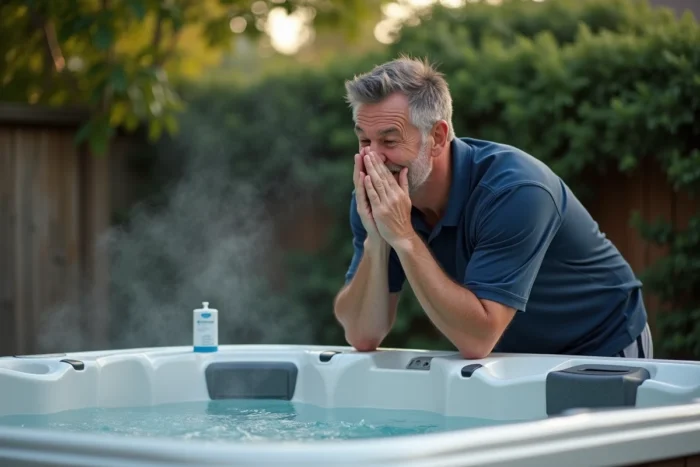
- Sharp odor upon opening the cover: it indicates an excess of chloramines, not an excess of free chlorine. Properly treated chlorine water is virtually odorless.
- Eye irritation and nasal burning sensation in the first minutes of bathing: trichloramine is to blame, not the pH (often wrongly accused).
- Persistent dry cough after the session, especially in children or asthmatic individuals: this symptom warrants medical advice and an immediate change of disinfectant.
Corrosion of spa equipment by chlorine and its derivatives
The internal components of a spa (heater, circulation pump, O-rings, brass fittings) are constantly immersed in hot, chemically charged water. Chlorine, even when properly dosed, remains a powerful oxidant that attacks metals and elastomers.
Electric heaters are the first components to suffer. Corrosion of the heating element or its stainless steel body manifests as greenish deposits, followed by a loss of thermal efficiency, and ultimately a leak. Pump seals and glued PVC fittings degrade faster in the presence of concentrated chlorine, especially when the pH drops below 7.2.
Acrylic shells also undergo premature aging. Regular overdosing causes surface whitening and micro-cracking that makes the shell porous, thus more difficult to disinfect afterward. This degradation cycle significantly increases maintenance costs over the spa’s lifespan.
Alternatives to chlorine for spas: bromine, active oxygen, and salt electrolysis
We recommend considering three technical alternatives, each suited to a different usage profile.
Bromine: the reference disinfectant in hot water
Bromine retains its biocidal effectiveness at high temperatures and high pH, two conditions that penalize chlorine. It does not produce irritating bromamines at the same level as chloramines. Bromine remains active even when the pH exceeds 7.6, making it much more stable in a spa environment.
Active oxygen: for sensitive skin
Hydrogen peroxide or potassium monopersulfate offer gentle disinfection without irritating residues. The downside: their persistence is low. They are suitable for spas used occasionally, with a limited number of bathers, and require frequent monitoring of the residual level.
Salt electrolysis
This system generates chlorine in situ from dissolved salt, but at much lower and more consistent concentrations than manual dosing. The main advantage is the absence of handling chemicals. The limitation: the initial investment in the electrolyzer and the need to monitor salt levels and pH.
- Bromine: ideal for frequent use, compatible with floaters and automatic brominators.
- Active oxygen: suitable for occasional users seeking maximum bathing comfort.
- Salt electrolysis: relevant for owners willing to invest in automation and wanting to reduce chemical handling.
The choice of disinfectant for a spa is not a matter of comfort preference, but a technical decision dictated by water temperature, basin volume, and frequency of use. Chlorine, effective in pools, becomes a health and equipment risk factor in a spa. Switching to bromine or active oxygen protects both the respiratory tract and the longevity of the equipment.