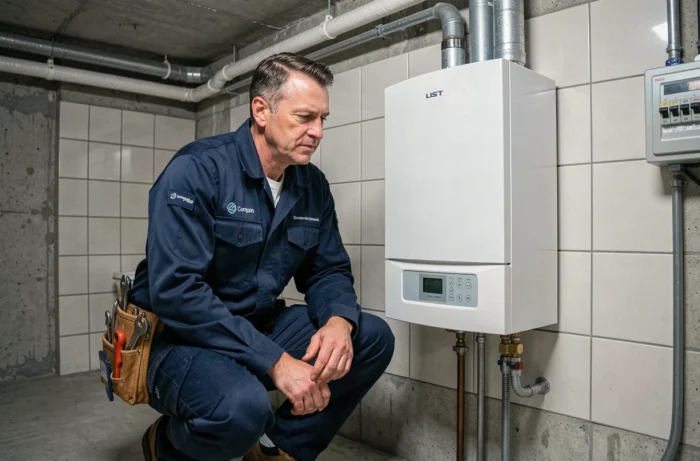
In a Brussels building, replacing an old boiler with a condensing model is not just about choosing a more efficient device. The collective structure imposes connection, drainage, and regulatory constraints that are not encountered in a single-family home. Understanding these specifics avoids extra costs and blockages in co-ownership.
Condensation in buildings: why water vapor changes everything
A traditional boiler expels its very hot combustion gases through the chimney. A portion of the energy literally escapes through the roof. The condensing boiler, on the other hand, cools these gases until the water vapor they contain returns to a liquid state. This change of state releases additional heat, called latent heat, which is reinjected into the heating circuit.
For this condensation to occur, the return water from the circuit must be sufficiently cold, ideally below 55 °C. A building equipped with oversized radiators or underfloor heating meets this condition well. In contrast, an old building with small cast iron radiators operating at high temperature reduces the actual gain from condensation.
In practice, when replacing an outdated atmospheric boiler, one typically recovers a significant portion of useful energy. This gain comes directly from recovering the heat contained in the flue gases, resulting in a higher efficiency than that of a conventional gas boiler.
Before considering installation, it is essential to understand the specifics of a condensing boiler in a rental building context, as the technical constraints are significantly different from those of a single-family home.
Flue gas and condensate drainage in a collective building
Have you noticed those metal ducts running along the facade of some Brussels buildings? They often indicate that a condensing boiler has been installed without being able to use the existing chimney. This is one of the most technical points of the project in co-ownership.
Relining the existing chimney
The flue gases from a condensing boiler are cold and acidic. They attack traditional masonry ducts. Therefore, relining with stainless steel or polypropylene is necessary inside the existing chimney. In a building, two solutions are available:
- Individual relining, where each apartment has its own duct lined within the common chimney. This option requires a chimney diameter sufficient to accommodate multiple tubes.
- Collective relining of the shunt type, which uses a shared duct with staggered connections. The shunt system imposes compatibility constraints between the devices installed on each floor.
- External relining on the facade, used when the existing chimney is too narrow or degraded. This solution requires a building permit in Brussels and the agreement of the co-ownership.
The choice depends on the condition of the duct, the number of connected devices, and the configuration of the building. A prior diagnosis of the duct by a certified professional is the first concrete step.
Drainage of condensates
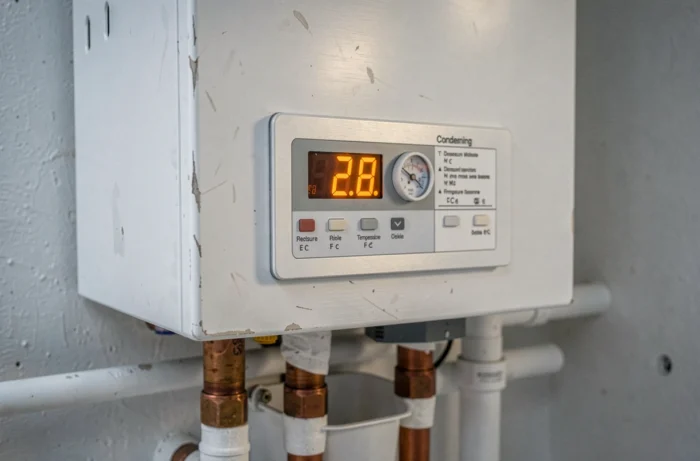
Condensation produces water that is slightly acidic (pH around 3 to 4 for gas). In a house, this water simply flows into the wastewater network. In a building, each individual boiler must have a connection to the wastewater system, which is not always provided for in the existing columns. The installation of a condensate neutralizer may be required depending on the drainage configuration.
Energy Performance Regulation in Brussels: new vs existing
The Brussels regulation has created a clear distinction since 2025 that many co-owners are unaware of. In new buildings, the installation of gas or oil boilers has been prohibited since January 1, 2025. This rule also applies to heavy reconstructions considered as new.
However, in an existing building already connected to gas, replacing an old boiler with a condensing gas boiler remains permitted in 2026. This is a crucial nuance for co-ownerships renovating their boiler room without altering the building’s structure.
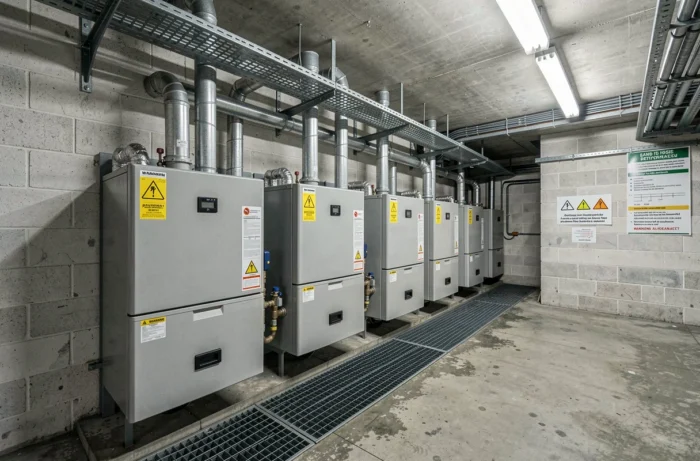
Another point to remember for buildings: any gas or oil boiler with an absorbed nominal power of 100 kW or more falls under classified installations in Brussels. An environmental permit or a prior declaration to the municipality is then mandatory, along with periodic checks and a regulatory logbook.
Grants and taxation: what has changed for gas in Brussels
Co-ownerships that relied on grants to finance the replacement of their gas boiler need to revise their calculations. Brussels no longer subsidizes the installation of fossil boilers since 2025. Regional grants are now reserved for heat pumps and renewable systems.
On the VAT side, the situation has also evolved. The reduced rate of 6% that applied to renovation work in homes over ten years old no longer covers gas or oil boilers. The applicable rate is now 21%, significantly increasing the installation bill.
For an apartment building, this double removal (grants and reduced VAT) changes the financial equation. The cost of a condensing boiler installed remains moderate compared to a heat pump, but the complete absence of public aid makes the comparison less favorable than before.
Co-ownership and collective decision: the often underestimated hurdle
Technical aspects alone are not enough. In a Brussels building, modifying the heating system or intervening on the common chimney requires a vote in the general assembly. Relining a collective duct, moving a drainage outlet to the facade, or connecting to the wastewater columns affects the common areas.
Each co-owner can install their own individual boiler, but as soon as the work affects a shared element, the required majority in the assembly applies. In practice, this means that the installation schedule depends as much on collective decisions as on technical constraints.
Replacing a condensing boiler in a Brussels building remains technically relevant for the existing structure, provided that three elements are checked in advance: the condition of the chimney duct, the compatibility of the heating circuit with a low-temperature regime, and the co-ownership’s ability to vote on work in the common areas. Without these three green lights, the project risks stagnating well before commissioning.