
A text received after midnight does not follow the same codes as a message sent in broad daylight. The nighttime context alters the perception of the text, its tone, and the expectations of both the sender and the receiver. Understanding what a late message means requires distinguishing between several mechanisms, from the most mundane to the most intention-laden.
Nocturnal disinhibition effect and late-night texts
The night acts as an inverted filter on communication. Psychologists refer to the online disinhibition effect, a phenomenon amplified when fatigue, loneliness, and darkness reduce usual social barriers. In the evening, the person sending a message feels less exposed to judgment, which encourages more direct, intimate, or impulsive texts.
This mechanism explains why a late-night text often seems more intense than an identical message sent at noon. The content hasn’t changed, but the recipient’s brain assigns it an urgency or additional depth, simply because the hour suggests that the sender made a conscious effort to write instead of sleep.
The question of receiving late-night texts arises equally from the sender’s and receiver’s perspectives, each projecting their own expectations onto a text that the night renders ambiguous.
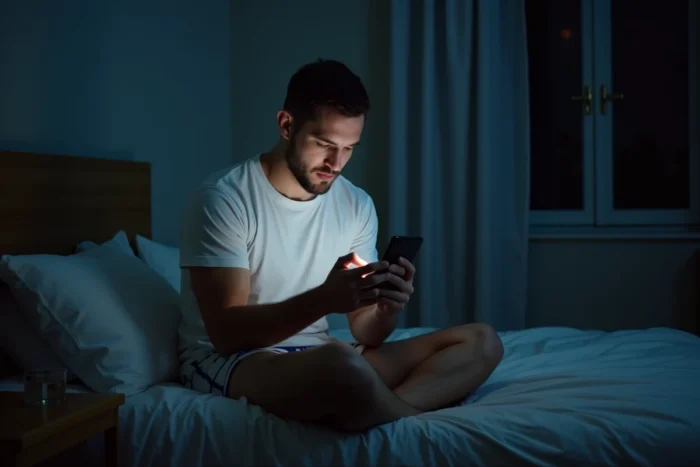
Real intentions behind a message sent at night
Not all late-night texts carry the same weight. Before drawing conclusions about a man’s or a woman’s intentions, one must examine the content, frequency, and relational context.
The one-off message after a night out
A text sent once, late, after a night out with friends, often stems from impulse. Alcohol, social excitement, or a sudden memory can trigger the sending. A solitary SMS after an evening rarely signals a deep intention. The best interpretation is to see if a second message follows in the coming days, this time during the day.
Regular late-night messages
Repetition changes the game. When a person sends texts late at night on a recurring basis, three hypotheses deserve to be distinguished:
- A romantic or loving interest that the person does not dare to express face-to-face or in a more formal setting, with the night serving as emotional cover.
- A need for social connection related to isolation or insomnia, without any particular sentimental intention, where the recipient plays the role of an available confidant.
- A couple’s habit or an established relationship, where the evening message serves as a ritual to close the day, a simple “good night” that maintains the connection.
The content of the message and the use of emojis help refine the interpretation. A factual text (“Did you see that movie?”) does not carry the same weight as a “I miss you” sent at two in the morning.
Late-night texts and legal limits in France
The relational dimension is not the only lens through which to view this. In France, a text can become a document with legal value depending on the context in which it is sent. Instant messaging conversations and texts are now treated as admissible evidence in many proceedings.
The CNIL also reminds that any SMS used for prospecting (commercial or otherwise) must comply with strict obligations of prior consent and the right to object, even when sent late in the evening or at night. An unsolicited late-night message can constitute an offense if it falls under solicitation or harassment.
This distinction between personal messages and formal communication gains importance in professional relationships. An employer or colleague who sends repeated texts outside of working hours exposes themselves to challenges regarding the right to disconnect. The Senate has identified the link between burnout and digital solicitations outside of hours as a growing concern.

Decoding a late-night SMS according to the relationship context
The interpretation of a late-night message depends almost entirely on the existing connection between the two people. Applying the same lens to a text from a close friend, an ex, a recent acquaintance, or a colleague leads to misjudgments.
Beginning of a romantic relationship
In the first weeks of a relationship, a late-night SMS carries a strong symbolic weight. The sender chooses to dedicate their last moments of consciousness to writing. The regularity of these messages matters more than their content. A “good night” sent every evening is worth more than a long passionate text sent just once.
Established relationship or couple
In a settled couple, late-night messages function differently. They become a marker of routine, not a signal of new interest. The sudden absence of these messages can indeed cause more worry than their presence.
Friendly or professional context
A friend who writes late at night may be going through a tough time. Night amplifies negative emotions, and the phone becomes the first accessible recourse. In a professional context, a message after a certain hour often reflects a lack of boundaries rather than a specific intention towards the recipient.
The meaning of a late-night SMS is found neither in the exact hour nor in the chosen words taken in isolation. It is constructed at the intersection of relational context, frequency, and the person’s overall behavior during the day. A morning message that confirms what a late-night text implied remains the only reliable indicator of a real intention.