Hanging a swing between two trees may seem simple, but the choice of trees, fastening materials, and shock-absorbing ground radically affects the installation’s lifespan and the children’s safety. This guide reviews the technical parameters to check before drilling or strapping anything.
Straps, through bolts, or rope: which fastening system to choose
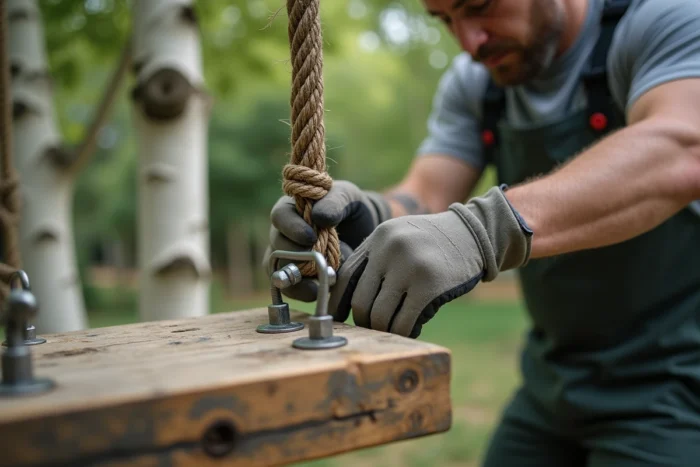
The fastening method determines both the strength of the whole setup and its impact on the tree. Three options consistently appear in setups between two trunks, but they are not all equal.
| System | Principle | Impact on the tree | Main limitation |
|---|---|---|---|
| Elastic straps (ratchet or flat strap) | Wraps around the trunk, supports a crossbar | Low if removed at the end of the season | Possible slipping under dynamic load |
| Through bolt (lag bolt / eyebolt) | Screws directly into living wood | Localized perforation, slow healing | Requires a sufficiently large trunk diameter |
| Rope tied around the branch | Friction on the bark | Progressive abrasion, risk of strangling the cambium | Rapid wear, difficult control |
Removable straps are recommended to limit injuries to the bark, especially on species with thin bark like birch or cherry. A through bolt remains the most mechanically stable fastening, but it requires working on a trunk of considerable diameter to avoid weakening the internal structure.
When looking to install a swing between two trees, the choice between these systems primarily depends on the species, trunk diameter, and expected frequency of use.
Tree assessment: trunk diameter, species, and health status
Not all trees can support the dynamic load of a swing. The dynamic load, meaning the force exerted by a moving user, far exceeds the static weight displayed on the scale.
Suitable species and species to avoid
Hardwood trees (oak, beech, hornbeam, maple) offer the best mechanical resistance. Fast-growing softwoods (poplar, willow, birch) break more easily under repeated stress. A dead tree or one with visible cavities in the trunk should be excluded, regardless of its diameter.
Minimum trunk diameter
A trunk that is too thin bends under load and eventually cracks. The field rule adopted by most anchoring kit manufacturers sets a minimum threshold well beyond what one might imagine for a simple children’s play. In case of doubt, measuring the circumference at the point of attachment and dividing by pi gives the actual diameter.
- Check for the absence of wood-decaying fungi (bracket fungus, polypore) on the trunk and exposed roots
- Inspect forks: a V-shaped fork with included bark is a potential breaking point
- Observe the canopy, as a tree with dry upper branches indicates advanced health decline
Shock-absorbing ground and safety distance around the swing
The fastening between two trees captures all the attention, while most injuries occur upon landing on the ground. A shock-absorbing surface under the swing area drastically reduces the severity of falls.
Types of shock-absorbing surfaces
Wood chips, coarse sand, or recycled rubber mats serve this function. The layer must be thick enough to absorb the impact of a fall from the maximum height of the seat. Mowed grass, even dense, does not provide a reliable shock-absorbing surface: it compacts and hardens within a few weeks of use.
Clearance zone
Ensure a free space in front and behind the swing at least equal to the length of the ropes or chains. Laterally, a clearance of at least one meter on each side of the seat prevents collisions with the trunks. This setback may seem generous for a small garden, but it conditions the actual safety of the installation.

Regulations and neighbors: what civil law requires (or not)
No minimum regulatory distance is set in French civil law between a swing and a separating fence. The project must remain entirely on your property and not create any encroachment or abnormal nuisance for the neighbors.
Depending on the configuration and the local urban planning plan (PLU) of the municipality, a prior declaration may be required. This mainly concerns permanent installations with concrete anchoring or fixed wooden structures between the two trees. A removable swing with straps generally escapes this obligation, but checking with the town’s urban planning department remains the only way to be certain.
- Consult the PLU for setback and ground coverage rules
- Ensure that swinging does not project the user beyond the property line
- Document the installation (photos, invoices) in case of future disputes with a neighbor
Seasonal maintenance and longevity of the installation
A swing between two trees endures the stresses of trunk growth. Each year, the trunk diameter increases and can encompass a strap or cable left in place. This phenomenon of inclusion causes strangulation of the cambium, which weakens the tree in the medium term.
Removing the straps at the end of the season and inspecting the fastening points the following spring is enough to prevent this problem. For through bolts, check for the absence of radial cracks around the drilling point. Replace carabiners, quick links, or ropes as soon as visible wear appears, even if the strength still seems adequate to the touch.
The most durable installation combines fastenings suitable for the species, well-maintained shock-absorbing ground, and regular visual checks. Neglecting the setup for just one season can turn a garden play into a structural risk, both for the children and the trees that support it.