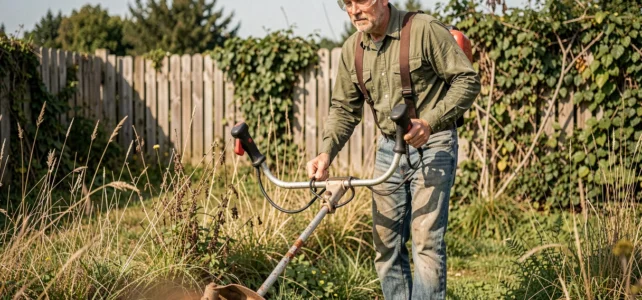
The thermal brush cutter remains the reference machine for mowing dense vegetation, clearing a slope, or maintaining a sloped terrain. Its gasoline engine provides autonomy and power that electric or battery models still cannot match on large areas. Choosing an appropriate model depends on specific technical criteria, often poorly prioritized in traditional guides.
Noise and vibrations of thermal brush cutters: a criterion that has become regulatory
Most comparisons focus on power and cutting system. The noise level and vibrations transmitted to the user’s arms deserve at least equal attention, not just for comfort.
The European regulation on machines (EU 2023/1230), which came into effect in July 2023, will become fully binding from January 20, 2027, for the marketing of outdoor motorized equipment. It requires that the compliance documentation includes aspects of noise, vibrations, and emissions as safety elements. Manufacturers are therefore encouraged to better characterize and reduce these levels in their new ranges.
In practical terms, a recent model displaying precise noise level and vibration data in its technical sheet indicates a more careful design. Field feedback varies on this point: some users find the announced levels optimistic compared to actual use. Comparing these data between models remains relevant, provided one relies on standardized measurements rather than marketing mentions.
On top-debroussailleuse-thermique.com, product sheets allow cross-referencing these technical details with user feedback, providing a more reliable overview than just the manufacturer’s specifications.
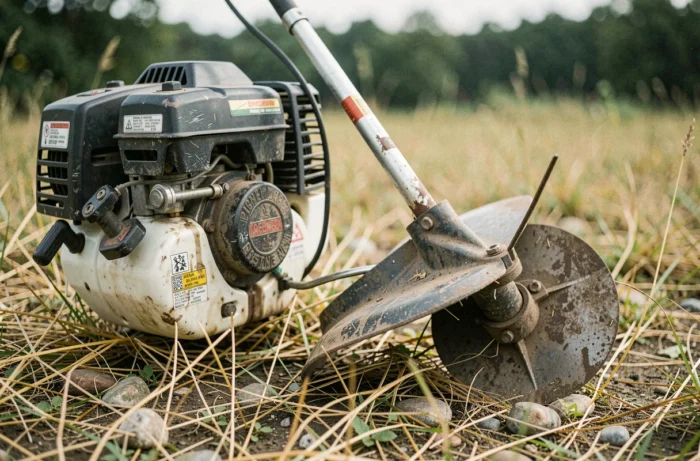
Engine displacement of the thermal engine: what the numbers really say
The displacement, expressed in cm³, is the first indicator of the cutting capacity of a thermal brush cutter. Competitors all mention it, but rarely with the distinctions that matter.
Small displacements and domestic use
Models between 21 and 30 cm³ are suitable for tall grass, edges, and finishing around obstacles. Their lightweight makes them manageable, but their torque quickly limits their effectiveness on brambles or woody shoots. If your terrain consists only of grass and a few weeds, a displacement around 25 cm³ is more than sufficient.
Medium displacements and uneven terrain
Between 30 and 40 cm³, the machine gains torque and accepts more demanding cutting heads (three-tooth blades, grass discs). This is the most versatile range for a medium-sized garden with sloped areas, occasional brambles, or seasonal undergrowth.
Above 40 cm³
These displacements are aimed at semi-professional or professional use. The weight increases significantly, and without a suitable harness, fatigue becomes a limiting factor after an hour of work. A powerful engine without a quality harness is counterproductive.
Two-stroke or four-stroke engine: a choice less clear-cut than it seems
The 2T engine has dominated the market for thermal brush cutters for decades. It is lighter at equal power, mechanically simpler, and its power-to-weight ratio remains superior. However, it requires a fuel/oil mixture and produces more emissions.
The 4T engine, offered by a few manufacturers, eliminates the mixture and reduces emissions. Its greater weight and more complex maintenance (oil change, oil level) hinder its adoption. The available data do not allow for a clear conclusion on a net advantage of the 4T for domestic use. For the majority of gardeners, the 2T engine remains the most practical choice in thermal.
The European regulation (EU) 2024/1781 on ecodesign, which formally replaces directive 2009/125/EC since July 2024, could eventually impose additional constraints on small power thermal engines. The specific delegated acts for gardening equipment have not yet been published, but the regulatory trend clearly points towards a reduction in emissions.
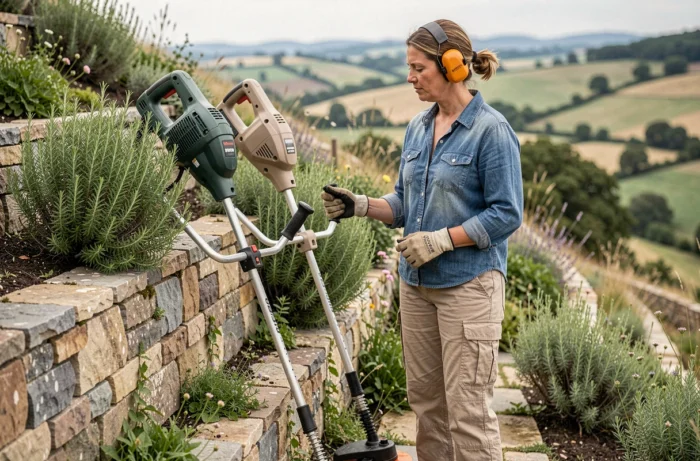
Cutting system: nylon line, blade, or disc depending on the vegetation
The choice of cutting system directly affects the machine’s efficiency. There are three main options, each with a well-defined usage scope.
- Nylon line: suitable for tall grass and finishing work. The diameter of the line (generally between 2 and 3 mm) must match the engine’s power. A line that is too thick on a small displacement causes the machine to stall, while a line that is too thin on a large engine wears out in minutes.
- Three or four-tooth blade: designed for undergrowth, brambles, and young woody shoots. It requires an engine of at least 30 cm³ to operate without straining. An appropriate blade guard and harness are then necessary.
- Brush cutter disc: reserved for powerful brush cutters (40 cm³ and above), it tackles tree shoots and dense vegetation. Its use requires complete protective equipment (visor, leg guards).
The versatility of a thermal brush cutter lies in its ability to change the cutting head. Check that the angle drive accepts both types of attachment (line and blade) before purchase.
Harness and handle: what makes the difference over time
Ergonomics distinguish a machine usable for half an hour from one that can be used for several hours. Two elements matter more than all others.
- The harness: a simple strap model is suitable for short sessions. For extensive or sloped terrains, a forestry-type harness (double shoulder with lumbar belt) distributes the weight over the hips and frees the arms. The difference in fatigue is considerable.
- The handle: bicycle-type handlebars offer better control on flat terrain and allow for wide sweeping. Loop or D-shaped handles are better suited for uneven terrain and narrow areas where maneuverability is key.
A model delivered with a basic harness can be upgraded after purchase, but the cost of a quality forestry harness represents a significant portion of the total budget. It is better to factor this in from the start when choosing the machine.
The weight of the brush cutter, combined with the type of harness and handle, determines the actual duration of use before fatigue. Prioritizing lightness over power makes sense if your sessions do not exceed an hour and the vegetation remains moderate. Otherwise, a heavier but better-equipped model will be more effective over time.