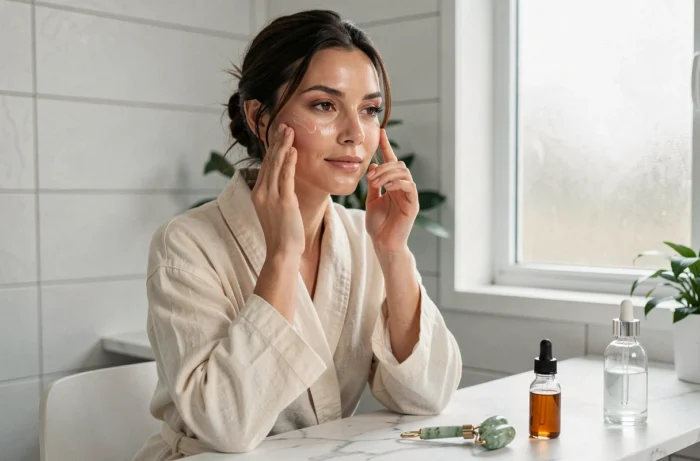
Natural skincare is no longer just about swapping a conventional bottle for one labeled “organic.” Expectations far exceed simple composition: label transparency, proof of effectiveness, traceability of raw materials.
What is really changing this year is the European regulatory framework and how it forces a rethink of what “natural” means on a tube of cream.
New European Rules on Allergens: What It Means for Natural Skincare
Have you ever turned a serum bottle to read the INCI list on the back? Starting July 31, 2026, this list will significantly expand. Regulation (EU) 2023/1545 requires brands to declare 82 fragrance allergens instead of 26, as soon as their concentration exceeds certain thresholds (0.001% for leave-on products, 0.01% for rinse-off products).
The paradox directly affects natural skincare. Essential oils of lavender, geranium, or ylang-ylang naturally contain several of these allergens. A “100% botanical” serum may therefore have a longer label than a synthetic formula designed to avoid them. Natural does not mean hypoallergenic, and this regulation makes the distinction visible.
For people with sensitive skin, this is a step forward: more information allows for the identification of problematic ingredients before purchase. For brands, it is an exercise in education. Those that clearly explain why a rose extract generates linalool on the label gain credibility. The catalogs offered on the Zaturelle beauty site allow for comparisons of compositions and help identify formulations suitable for reactive skin.
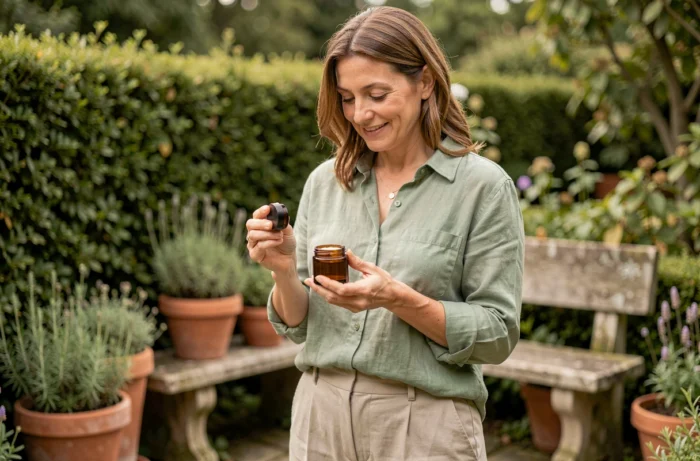
Minimalist Beauty Routine: Choosing Fewer Products to Better Protect Your Skin
The trend of skinimalism, popularized by simplified Korean routines, is based on a concrete principle: reducing the number of applied products limits interactions between active ingredients. Layering a vitamin C serum, a retinol cream, and tea tree essential oil on the same night can cause irritations that each product alone would not have caused.
A minimalist routine is built around three steps:
- A gentle cleanser, free from harsh sulfates, that preserves the hydrolipid film instead of stripping it away
- A single active treatment, chosen based on the primary need (hydration, radiance, firmness), applied to clean skin
- A sunscreen in the morning, even in winter, because UV rays remain the primary factor in skin aging
This refocusing does not mean sacrificing effectiveness. A well-formulated serum with one or two concentrated actives (like bakuchiol, a plant-based alternative to retinol) can yield better results than a succession of five layers of products that neutralize each other.
How to Know if Your Routine is Overloaded
A simple signal: if your skin feels tight, turns red, or produces more oil since you added a product, it is often the combination that is problematic, not your skin type. Removing a product for two weeks is enough to identify the culprit.
Fermentation and Biotechnological Actives in Natural Cosmetics
Fermentation is not new in food, but its application in natural cosmetics takes on a new dimension. The principle: to have microorganisms (yeasts, lactic bacteria) work on a plant substrate to produce molecules that the plant alone does not release in sufficient quantities.
A fermented rice extract, for example, contains amino acids and peptides absent from the raw grain. These molecules penetrate the stratum corneum better and strengthen the skin barrier without the addition of synthetic preservatives. Fermentation acts as a pre-digester: it breaks down large plant molecules into smaller fragments, directly assimilable by the skin.
Topical Probiotics and Microbiome Balance
The skin hosts billions of microorganisms that contribute to its defense. Creams enriched with probiotic lysates (fragments of beneficial bacteria) aim to nourish this ecosystem rather than sterilize it.
The approach is still young, and clinical evidence is gradually building. What is documented: formulations based on postbiotics (metabolites produced by fermentation) show results in soothing skin prone to redness. The active principle is not the living bacteria, but what it has produced.
Reading a Natural Skincare Label: Reflexes That Protect
The proliferation of labels (organic, clean, vegan, natural) creates legitimate confusion. Two concrete reflexes help sort information on packaging:
- Check the position of the actives highlighted by marketing in the INCI list. An ingredient located after preservatives represents less than 1% of the product. If the brand sells a “bakuchiol treatment” but bakuchiol appears at the end of the list, the concentration is negligible
- Look for mandatory allergen mentions, especially if you have reactive skin. With the new regulation, a long label is not a bad sign but a guarantee of transparency
- Distinguish “of natural origin” (which can include chemically modified derivatives) from “natural” (ingredient used as is or with minimal transformation like distillation)
These checks take thirty seconds and prevent you from buying a product based solely on green packaging and a botanical name in golden letters.
The market for natural skincare is evolving towards greater scientific and regulatory rigor. Effective formulations are recognized by their verifiable composition, not by their marketing promises. Choosing a product suitable for your skin requires fewer products and more reading, which, in the end, simplifies the routine as much as the budget.