
A blood test returns with gamma-GT levels above the norm, while alcohol consumption is negligible or non-existent. This result is perplexing because the association between gamma-GT and alcohol remains a common medical reflex. However, gamma-glutamyl transferase circulates in several organs (liver, pancreas, kidneys), and its elevation primarily indicates hepatic stress, which can be metabolic, drug-related, or biliary in origin.
Elevated gamma-GT and metabolic steatosis: the first diagnosis to rule out
Metabolic-associated fatty liver disease (MASLD, formerly NAFLD) is now the leading documented cause of elevated gamma-GT in non-drinkers. This point is often underestimated when interpreting a standard liver panel.
The liver accumulates fats due to a combination of overweight, insulin resistance, or metabolic syndrome. This fatty infiltration is sufficient to raise gamma-GT levels, sometimes significantly, without any alcohol involvement. To better understand the causes of elevated gamma GT levels in the absence of alcohol, the metabolic pathway should be prioritized in any diagnostic approach.
Recent studies go further: elevated gamma-GT in the context of metabolic steatosis is associated with a increased risk of early coronary artery disease and heart failure. Therefore, GGT is no longer just a hepatic marker; it is now integrated into the overall cardiometabolic risk assessment.
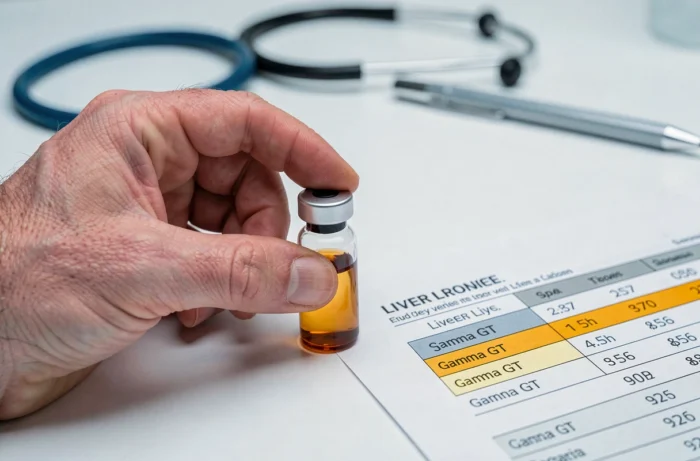
Non-alcoholic causes of elevated gamma-GT: comparative table
Several distinct mechanisms can explain an increase in gamma-GT without alcohol consumption. The following table summarizes the main situations encountered in clinical practice.
| Cause | Main Mechanism | Associated Markers in the Panel |
|---|---|---|
| Metabolic steatosis (MASLD) | Fatty infiltration of the liver related to metabolic syndrome | ALAT often moderately elevated, abnormal liver ultrasound |
| Hepatotoxic drugs | Enzyme induction or direct toxicity | Isolated gamma-GT, ASAT/ALAT normal or slightly disturbed |
| Cholestasis (biliary obstruction) | Blockage of bile flow (stone, tumor, stenosis) | Elevated alkaline phosphatases, increased bilirubin |
| Viral hepatitis (B, C) | Chronic inflammation of the hepatic parenchyma | Elevated ASAT/ALAT, positive serologies |
| Hyperthyroidism | Acceleration of hepatic metabolism | Low TSH, elevated free T4 |
This table shows that the profile of associated markers guides the diagnosis much more than gamma-GT alone. An isolated GGT, without disturbances in transaminases or alkaline phosphatases, points towards a drug-related or early metabolic cause.
Medications that raise gamma-GT without hepatic pathology
Some common treatments cause an elevation in gamma-GT through simple enzyme induction, without liver damage. The phenomenon is dose-dependent and reversible upon discontinuation of the treatment.
- Antiepileptics (phenytoin, carbamazepine, phenobarbital) are among the most potent enzyme inducers. A moderate elevation of GGT under these treatments does not indicate hepatic distress.
- Statins, prescribed to lower cholesterol, can increase gamma-GT in a notable proportion of patients, generally without clinical consequences.
- Azole antifungals (fluconazole, itraconazole) engage hepatic metabolism and frequently disrupt the enzyme panel.
- Some antihypertensives and oral contraceptives are also documented as GGT inducers.
Before initiating further explorations, reviewing the current prescription remains a simple and often sufficient diagnostic step. A physician faced with a moderately elevated gamma-GT without other abnormalities in the liver panel will primarily check the list of medications.
Isolated moderately elevated gamma-GT: should we be alarmed?
Recent practical recommendations emphasize a structured observation strategy rather than an immediate invasive assessment. A GGT slightly above the norm, without alcohol and without abnormalities in ASAT, ALAT, or alkaline phosphatases, does not justify a liver biopsy as a first intention.
The usual approach is to recheck the dosage after a few weeks, having ruled out drug-related causes and corrected any potential metabolic factors (diet, physical activity, weight loss if necessary). If the GGT remains elevated or increases, a liver ultrasound can be performed to check for steatosis or biliary abnormalities.

The threshold of concern depends on the clinical context
Reference values vary by laboratory. In men, the upper limit is generally around 55 UI/L, and around 38 UI/L in women. A moderate exceedance (up to twice the norm) in a known metabolic context does not carry the same significance as a marked elevation with jaundice and abdominal pain.
In contrast, a gamma-GT that significantly exceeds the norm, associated with elevated alkaline phosphatases and increased bilirubin, points towards cholestasis that requires prompt imaging.
Gamma-GT and cardiovascular risk: an underestimated link
The classic reading of a liver panel often focuses solely on the liver. Cohort data published in recent years show that elevated gamma-GT, even without alcohol, acts as an independent marker of cardiovascular risk. The link largely involves oxidative stress and chronic low-grade inflammation associated with metabolic steatosis.
A non-drinker with persistently elevated GGT and an unfavorable metabolic profile (increased waist circumference, borderline blood sugar, high triglycerides) should undergo a cardiological evaluation, not just a hepatic one. This cross-sectional reading of the blood panel is still not widespread in primary care.
Thus, elevated gamma-GT without alcohol is neither trivial nor catastrophic. It indicates a metabolic condition to explore, a treatment to review, or, more rarely, a biliary or hepatic pathology that needs to be addressed. An isolated dosage is never sufficient to conclude: it is the intersection with other markers in the liver panel and the clinical context that gives the result its true meaning.