
The “mobile terminals” position of a professional fleet is rarely negotiated based on the displayed unit price. The variable that determines the actual profitability is the supplier’s ability to absorb the logistical, regulatory, and lifecycle constraints that the company cannot manage internally. Working with a specialized wholesaler changes the equation on each of these points.
Repairability and European Directive: What the wholesaler must contractually guarantee
The Directive (EU) 2024/1799 known as the “Right to Repair” changes the game for fleet buyers. Manufacturers must now provide spare parts at reasonable prices, within capped deadlines of five to ten working days depending on the component. Disassembly manuals and technical information must be accessible to third-party repairers.
The Ecodesign Regulation (EU) 2023/1670, specific to smartphones and tablets, reinforces this logic by imposing documentation of repair procedures and the durability of components (battery, screen, connectivity).
For a fleet of several dozen or hundreds of terminals, these obligations create a concrete negotiation lever. A B2B-oriented wholesaler who masters these texts can integrate service level commitments on repair times and the availability of parts into their contracts. We recommend requiring these clauses in writing before any bulk order, as they directly condition the total cost of ownership.
At the same time, the gradual arrival of the Digital Product Passport (DPP) for electronic equipment, planned under the Ecodesign Regulation, will allow tracking each terminal throughout its lifecycle. A wholesaler capable of integrating this data into their system facilitates WEEE audits and end-of-life management.
Structuring the purchase of professional smartphone fleets around these regulatory criteria secures the supply chain for several years, beyond just the initial purchase price.

Total Cost of Ownership of a Smartphone Fleet: The Items That the Catalog Price Masks
The TCO of a professional terminal far exceeds the negotiated price at the order. We observe that companies systematically underestimate three items.
- Breakage and downtime: a non-functional smartphone means a slowed field employee. The indirect cost (loss of productivity, temporary replacement, logistical expenses) often exceeds the price of the terminal itself.
- Early renewal: a model that is not durable or poorly suited to actual usage conditions (dust, moisture, shocks) forces a replacement before the end of the planned cycle, negating the savings made at purchase.
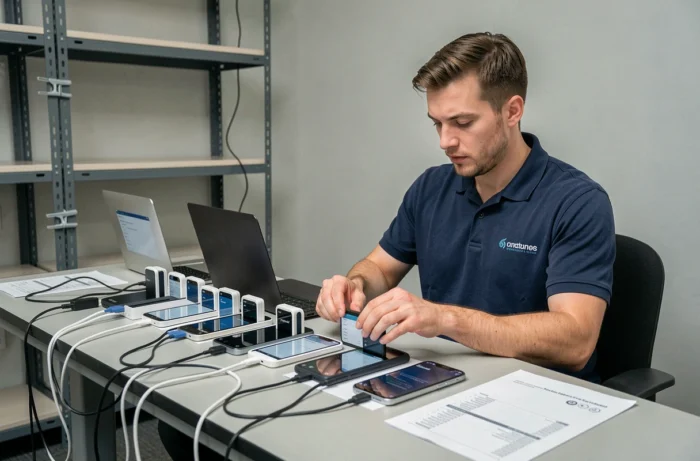
- Administrative management: initial configuration, MDM enrollment, WEEE recovery. Each step has an hourly cost. A wholesaler that delivers pre-configured and pre-enrolled terminals significantly reduces this item.
Opting for the cheapest model in the catalog remains the most costly reflex in the medium term. A more durable terminal with a controlled TCO consistently outperforms a cheap, high-turnover terminal.
Selection of the Specialized Wholesaler: Technical Criteria to Check Before Signing
Not all mobile phone wholesalers target the same segment. Some operate in consumer refurbishment, while others focus on new volume distribution. For a professional fleet, the supplier’s specifications must cover specific points.
Logistical Capacity and Deadlines
A wholesaler supplying fleets must be able to deliver a homogeneous volume (same model, same firmware, same regional configuration) in a single batch. Fragmented deliveries complicate MDM enrollment and create software version discrepancies within the fleet.
Certifications and Compliance
Check that the wholesaler distributes terminals compliant with current CE standards, compatible with the USB-C universal charger directive (Common Charger Directive) applicable from the end of 2024 for smartphones. A non-compliant batch exposes the company to complications during an audit or resale at the end of the cycle.
Value-Added Services
Android Enterprise pre-enrollment (zero-touch enrollment), laser engraving of internal identifiers, individualized packaging by site or employee: these services differentiate a generalist wholesaler from a supplier structured for B2B. We recommend systematically requesting a separate quote for these services, as they are sometimes included in the unit price without being visible.
WEEE Management and End-of-Cycle: Legal Obligation and Financial Lever
The WEEE (waste electrical and electronic equipment) regulation requires companies to track and recycle their terminals at the end of life. For a significant-sized fleet, the recovery of old terminals can finance part of the renewal.
A specialized wholesaler that integrates a buy-back program into its offer simplifies WEEE compliance while generating residual value. The amount depends on the model, the condition of the terminal, and the refurbished market at the time of recovery.
Be cautious about a often overlooked point: certified data wiping before return. If the wholesaler does not provide a compliant data wiping certificate, the legal responsibility in case of data leakage remains with the company. Requiring a documented protocol (such as NIST 800-88 or equivalent) protects against this risk.
Operator Packages and Terminal Purchases: Should the Two Be Decoupled?
Buying terminals through the telecom operator simplifies billing but reduces negotiation margins. Operators generally offer a limited range of models, with rigid renewal conditions.
Decoupling the purchase of smartphones (via a wholesaler) and the subscription of packages (directly from the operator) allows for optimizing each item independently. The wholesaler negotiates the terminal price based on volume, while the operator adjusts the packages to the actual usage of the lines.
This separation also provides more flexibility during partial renewals, when only certain terminals need to be replaced without affecting the active lines. Companies that maintain this lever avoid cross-commitments that increase the overall cost of the fleet over multiple fiscal years.
The choice of wholesaler conditions the economic and operational performance of the fleet well beyond the initial order. Guaranteed repairability, documented TCO, tracked regulatory compliance, recovery at the end of the cycle: these four axes structure a supply chain that withstands the test of the field.