
Receiving mail on non-buildable land raises a question that intertwines postal law, urban planning, and domiciliation. The confusion between postal address, residence, and legal domicile fuels contradictory answers on forums. The real issue lies at the intersection of several regulations that do not oppose each other in the way one might think.
Postal address and legal domicile on non-buildable land: two distinct concepts
The starting point is often misframed. The question is not whether non-buildable land can “have an address,” but what this address legally allows one to do.
| Concept | Definition | Link with non-buildable land |
|---|---|---|
| Postal address | Delivery point for mail identified by La Poste | Possible if a standardized mailbox is accessible from the public road |
| Residence | Place where a person lives relatively stably | Requires actual stay, not just a cadastral plot |
| Domicile | Unique place of a person’s main establishment (Civil Code) | Requires actual living there to produce legal effects |
A non-buildable plot does not prevent having a postal address. However, it does prevent establishing a domicile in the sense of the Civil Code if no one actually resides there. This distinction is crucial for the proof of residence required by the administration.
The plot may appear in the land registry with a reference and a place name. This is sufficient for La Poste to identify a distribution point, provided that the material criteria are met. To delve deeper into this mechanism, you can learn more on Le Guide Immobilier 74, which details the procedures plot by plot.
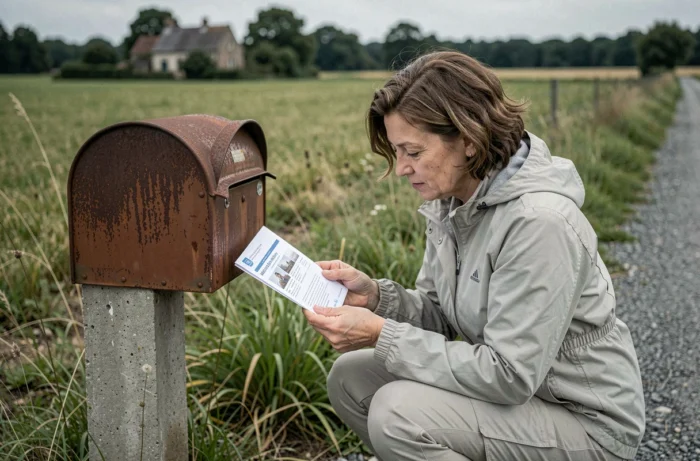
Standardized mailbox on bare land: the actual postal conditions
The delivery of mail does not depend on the buildability of the land. It depends on the accessibility of the delivery point. ARCEP, in its consolidated postal directive, emphasizes a simple criterion: the mailbox must be standardized and accessible from the public road.
On bare land, this concretely implies several requirements:
- The mailbox must be installed at the edge of the road, not in the middle of the plot. The mail carrier does not enter private land without an accessible path.
- It must be identified with the recipient’s name. Without identification, La Poste has no obligation to deliver.
- The land must have a sufficient reference (road number, place name, cadastral reference known to the distribution office) to appear in the postal address database.
In practice, if the land is located in a place name without road numbering, one must contact the town hall to obtain a usable address. Some rural municipalities have not yet finalized their numbering, complicating the process.
What to do if the municipality does not recognize the address?
General delivery is an alternative. The postal code allows receiving mail at the nearest post office, without any link to a specific plot. This solution does not create any right of domiciliation but guarantees the effective receipt of mail.
General delivery does not generate proof of residence. For administrative procedures that require this document (voter registration, vehicle registration, taxes), one needs an actual residence address.
Urban planning and domiciliation: what the urban planning code really allows
The classification of land as non-buildable (zone N or A of the local urban plan) prohibits new constructions for residential use. It does not, in itself, prohibit the installation of a mailbox, which is not considered a construction under the urban planning code.
The confusion arises from the following shortcut: no construction, therefore no residence, therefore no address. This reasoning ignores that the postal address exists independently of the right to build. Agricultural land, a forest, a plot in a natural zone all have a cadastral reference.
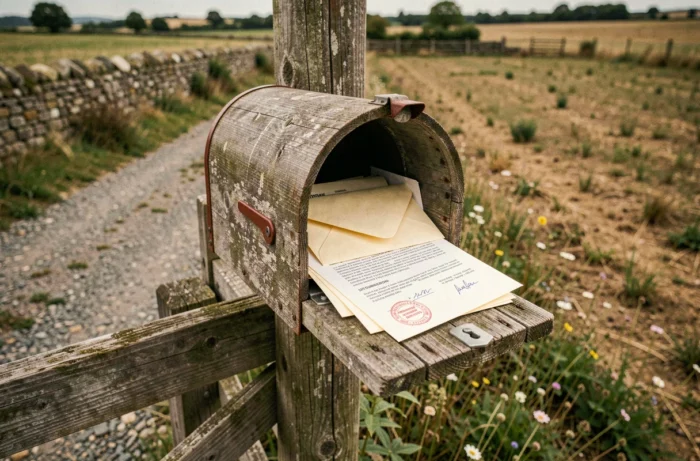
The trap of proof of residence
Receiving mail on non-buildable land does not pose a major technical difficulty. The problem arises when one tries to use this address as a declared domicile.
Administrations require proof of residence (utility bill, home insurance certificate, tax notice mentioning the address). On land without connections or construction, these documents do not exist. Without proof of residence, the address remains postal but not administrative.
Some owners attempt to circumvent this limitation by installing a light dwelling (caravan, tiny house). However, the prolonged parking of a mobile residence on non-buildable land is itself subject to urban planning rules, especially beyond three consecutive months.
Dematerialization and mail on non-buildable land: what has changed recently
The dematerialization of urban planning procedures, accelerated in recent years, has changed the practical context. Many municipalities now require electronic submission for legal entities while retaining options for postal or physical submission for individuals.
This evolution means that “the address of the land” is now treated more as an administrative file data than as a place of residence. For a preliminary declaration or a development permit, the cadastral reference is sufficient. To live there and receive mail daily, the requirements remain those of civil law.
Conversely, domiciling a sole proprietorship at the address of non-buildable land poses additional difficulties: the CFE (business formalities center) generally requires proof of occupancy of the premises, which bare land does not allow one to provide.
Installing a mailbox on non-buildable land and receiving mail there remains technically possible and legally not prohibited, provided one does not confuse this postal convenience with a right of domiciliation. The limit is not in the stamp, but in what the administration accepts as proof of residence.